
Scheduled: goes live on October 9, 2026. Only you can see it because the admin panel is open.
Published on October 9, 2026 · 10 min read
Where to Place a Stop Loss: 5 Methods With Worked NQ Examples
Five ways to set a stop, worked on NQ in ticks and dollars: beyond structure, ATR multiples, session volatility, time and a hard money cap. Plus why obvious stops get swept and when moving one is allowed.
Place a stop loss at the price that proves your trade idea wrong, not at the loss that feels comfortable. For most intraday trades that means just beyond the swing high or low that defines the setup, checked against volatility (ATR) and capped by a maximum money loss. Then you calculate the position size from that stop distance. Below are five methods, each worked on NQ in ticks and dollars.
In short
- The stop goes where the idea is invalid. Size adapts to the stop, never the other way round.
- Use ATR to check that a structure stop is not sitting inside normal noise.
- Obvious stops, one tick past equal lows or a round number, are where liquidity rests. Add a buffer or wait for the sweep.
- Move a stop only in your favour, by a rule written before the entry. Never widen it.
Where to place a stop loss: the one principle
A stop loss answers one question: at what price is my reason for this trade gone? If you buy NQ because it held a level at 21,500, and price then trades back down through the low that confirmed the hold, the reason has gone. Staying in is no longer a trade, it is hope.
The common beginner method works backwards: "I will risk 100 dollars, so my stop is 5 points away." On NQ, 5 points is 20 ticks, and at the New York open a single five-minute candle can be three times that size. The stop then sits inside normal noise and gets hit by movement that says nothing about the idea.
The numbers used below:
- NQ: 1 tick = 0.25 points = 5 dollars; 1 point = 20 dollars.
- MNQ (the micro): 1 tick = 0.25 points = 0.50 dollars; 1 point = 2 dollars.
Same chart, same ticks, one tenth of the money: that is how a small account keeps a correct stop.
5 stop loss placement methods, with NQ examples
All five examples use the same trade: a long on NQ at 21,520.00 after a pullback that bottomed at 21,503.50.
1. Structure: beyond the swing low or high
For a long, the stop goes below the swing low that the setup depends on; for a short, above the swing high. Add a buffer so a touch of the level does not take you out. With the low at 21,503.50 and a 3-tick buffer, the stop is 21,502.75.
Distance: 21,520.00 minus 21,502.75 = 17.25 points = 69 ticks. Risk per contract: 69 × 5 = 345 dollars on NQ, or 34.50 dollars on MNQ. Structure stops only work if the level is real; the guide to which support and resistance levels matter helps you tell a level from a line someone drew.
2. ATR multiple
The Average True Range, introduced by J. Welles Wilder in 1978, measures how far price typically moves per candle. Suppose the 14-period ATR on the five-minute chart is 11 points. A stop at 1.5 × ATR is 16.5 points below entry: 21,503.50. That is 66 ticks, 330 dollars per NQ contract.
ATR works best as a check on the structure stop rather than a replacement. If the swing low is less than one ATR away, the stop is probably inside the noise: widen it to the next structural point and cut size, or skip the trade. A pure ATR stop ignores the chart, so it can land one tick above a level everyone can see.
3. Volatility of the instrument and the session
A stop distance only means something relative to how the market is moving right now. Measure the median five-minute range on your instrument in two windows. With hypothetical figures: 14 points between 9:30 and 10:00 New York time, and 6 points between noon and 1:00 p.m. A 12-point stop is less than one candle at the open and two full candles at lunch.
Two rules follow. Never copy a stop distance in points from one instrument to another: 12 points on NQ and on ES are different trades. And keep a minimum stop per session window, such as one median candle, re-measured every month.
4. Time stop
Some setups only work if they work fast. A breakout still sitting at the entry price fifteen minutes later has usually lost its reason. A time stop closes the trade if it has not reached a set level within a set time.
Example: long at 21,520.00, structure stop at 21,502.75. Rule: if price has not reached 21,530.00 (+10 points) within three five-minute candles, exit at market. If you get out at 21,516.00, the loss is 4 points, 80 dollars, instead of the full 345. A time stop always sits on top of a price stop, never instead of one.
5. Maximum money loss
A fixed cap per trade, usually a percentage of the account. It does not decide where the stop goes. It decides how many contracts you trade, and whether you take the trade at all.
With a 20,000-dollar account and a 1% cap, you can lose 200 dollars per trade. The structure stop costs 345 dollars on one NQ, so NQ is out. On MNQ it costs 34.50 per contract: 200 ÷ 34.50 = 5.8, rounded down to 5 contracts, which risk 172.50 dollars. The wrong fix is to squeeze the stop to 10 points so one NQ fits the 200 dollars. That puts the stop right back inside the noise.
Stop loss methods compared
| Method | Where the stop goes | NQ example | Weak point |
|---|---|---|---|
| Structure | Beyond the swing low or high, plus a buffer | 69 ticks, 345 dollars | Useless if the level is not real |
| ATR multiple | 1 to 2 ATR from entry | 66 ticks, 330 dollars | Ignores the chart and visible levels |
| Session volatility | At least one median candle of that window | Minimum 14 points at the open | Needs regular re-measuring |
| Time stop | Exit if no progress after N candles | Out at -4 points, 80 dollars | Never a substitute for a price stop |
| Money cap | Sets size, not location | 5 MNQ, 172.50 dollars | Misused to squeeze stops tighter |
In practice you combine them: structure decides the location, ATR and session volatility check it, the money cap sets the size, and the time stop cuts trades that go nowhere.
Why obvious stops get swept
A stop on a long position is a sell order waiting below the market. When many traders put theirs one tick under the same equal lows, the previous day's low or a round number, that price becomes a pool of resting sell orders. When price trades through it, those stops turn into market orders at once, which is exactly the liquidity a large buyer needs to fill size without chasing. Price pokes through, the stops fire, and the move reverses. It does not take a conspiracy, only orders sitting where everyone can guess them. The guide to order blocks and liquidity separates the useful part of this idea from the jargon.
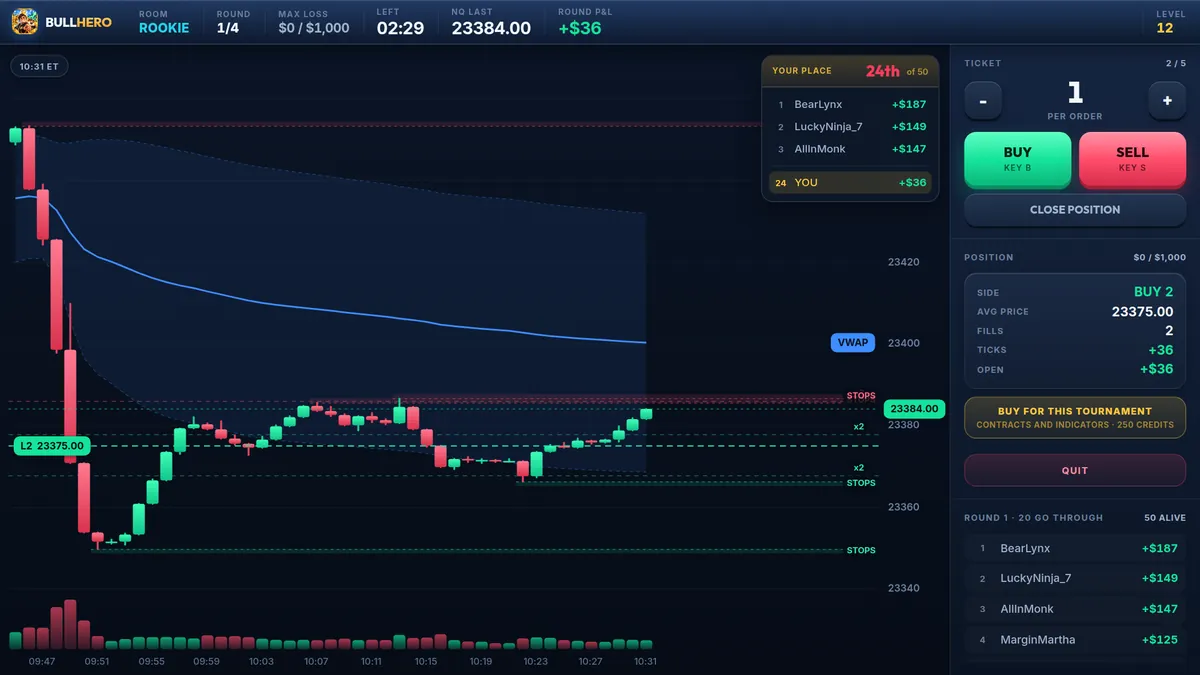
Three ways to avoid being part of the pool:
- A wider buffer. Put the stop a fraction of ATR beyond the level (a quarter of ATR, for instance), not one tick past it, and reduce size to keep the money risk the same.
- The next structure point. Use the swing behind the obvious one. The stop is wider, so size drops again.
- Wait for the sweep. Let price take the stops first, then enter once it closes back above the level. Example: equal lows at 21,480.00, a sweep down to 21,476.50, then a close back above 21,480. Long at 21,482.00 with the stop 1 point under the sweep low, at 21,475.50: 6.5 points, 26 ticks, 130 dollars per NQ.
Stop distance vs position size: size from the stop
The order never changes: find the stop first, then size. The formula is contracts = money at risk ÷ (stop in ticks × tick value).
- Find the invalidation price on the chart.
- Measure the distance from entry in ticks.
- Multiply by the tick value of the contract.
- Divide your risk per trade by that number and round down.
- If the answer is below one micro contract, skip the trade.
On a 5,000-dollar account risking 1%, you have 50 dollars per trade. The structure stop of 69 ticks costs 34.50 dollars per MNQ, so you trade 1 contract. The sweep entry with a 26-tick stop costs 13 dollars per MNQ, so you trade 3 (39 dollars at risk). Same risk rule, different stop, different size. More on the rule itself in risk management for beginners: size before entry.
Practise putting the stop beyond the sweep, not inside it. BullHero's tape includes liquidity sweeps that take the obvious highs and lows, and each room has a maximum loss per round (1,000 play dollars in ROOKIE), so a stop placed in the pool costs you the round.
Test your stopsWhen to move a stop loss, and when never to
Moving a stop is allowed in one direction only, towards your profit, and only by a rule you wrote before entering. Three legitimate cases:
- To break even after a condition. Not at the first tick of profit. For example: once price reaches +1R and forms a new higher low. Set it a couple of ticks past entry so costs are covered.
- Trailing behind structure. On a trend trade, move the stop below each new higher low.
- Before a scheduled release, if your plan says to tighten or close ahead of macro data.
Example: long at 21,520.00 with the stop at 21,502.75, so 1R is 17.25 points. Price reaches 21,537.25 (+1R) and pulls back to a new higher low at 21,526.00. Moving the stop to 21,525.75, a tick under that low, locks in 5.75 points: 23 ticks, 115 dollars per NQ.
Never move a stop further away because price is approaching it, never remove it, and never move it to break even out of fear before the setup has room to work. In your trading journal, record the stop as placed and as moved: that column alone exposes most of these habits within a fortnight.
Frequently asked questions
Should I use a mental stop loss instead of a real order?
For beginners, no. A mental stop depends on you clicking at the worst moment of the trade, which is exactly when hesitation is strongest. A resting stop order works even if you freeze, lose connection or look away. Experienced traders who use mental stops have years of data showing they act on them.
What percentage should a stop loss be?
There is no correct percentage of price for intraday futures: think in points relative to structure and ATR, not in percentage moves. The percentage that matters is the share of your account lost if the stop is hit. Many risk guides suggest keeping it around 0.5 to 1% per trade for beginners, and setting size from that.
Why does my stop loss always get hit right before price reverses?
Usually because the stop sits where everyone else's does: one tick past equal lows, the previous day's low or a round number. Those levels attract sweeps. Add a buffer of a fraction of ATR, use the next structure point with smaller size, or wait for the sweep to happen and enter after it.
Is a stop loss guaranteed to fill at my price?
No. A standard stop becomes a market order once triggered, so it fills at the next available price. In a fast market or around a data release that can be several ticks worse, which is called slippage. A stop-limit avoids slippage but may not fill at all, which is usually the bigger risk.
BullHero is a trading game that uses play money and a price tape generated by a mathematical model; it is not a broker. Nothing in this article is financial advice: it is written for education.
Sources
- Wilder, New Concepts in Technical Trading Systems, 1978
- SEC, Investor Bulletin: Stop, Stop-Limit, and Trailing Stop Orders, 2017
- CME Group, Micro E-mini Nasdaq-100 Futures: Contract Specifications, 2019
More articles
How to Keep a Trading Journal That Actually Changes Your Results
Eight fields, a template you can copy and a weekly review that hunts for one leak at a time: how to log live trades and practice rounds so your data tells you what to fix next.
Best Apps to Learn Trading: What Each Type Trains and How to Pair Them
Broker demos, charting apps with paper trading, courses, flashcards and tournament games: what each kind of app really teaches, which two to combine and a four-week plan you can run on your phone.

The Best Trading Simulator Games to Learn Trading Without Risking Money
Broker demos, bar replay, portfolio contests, prop firm exams and short tournaments: what each one actually trains and what none of them can. Plus a practice routine that turns screen time into skill.