
Published on October 23, 2026 · 8 min read
Overtrading: 6 Warning Signs, What It Costs and How to Stop It
Boredom, revenge and no plan: why traders take too many trades, what costs do to a 40-trade day compared with a 6-trade day, and the rules and journal checks that bring the count back down.
Overtrading means taking more trades, or bigger ones, than your plan allows: entries without a valid setup, outside your session window or to win back a loss. It is one of the most common ways beginners lose money, because every extra trade pays spread and commission and most are taken in a poor state of mind. This article covers the six warning signs, the causes, the cost maths and the fixes that work.
In short
- Overtrading is any trade your written plan would not have allowed. It is not a fixed number per day.
- Costs scale with the count: at 9 dollars per NQ round trip, 40 trades cost 360 dollars a day before you are right once.
- The fixes are mechanical: a trade limit per session, a pause after two losses and a setup checklist.
- Measure it weekly in your journal: trades with no setup, trades right after a loss and results by trade number.
What is overtrading?
Overtrading has two forms. Frequency: too many trades, most of them outside your plan. Size: positions bigger than your rules allow, typically doubling up after a loss. Both come from the same place: acting because you want to act, not because the market gave you your setup.
The number alone does not define it. A scalper whose plan allows fifteen trades in a window and takes fifteen is not overtrading. A trader whose plan allows two and takes five is, even if five sounds modest.
The cost is well documented. In a classic study of 66,465 US households at a discount broker between 1991 and 1996, Barber and Odean found that the households that traded most earned an annual return of 11.4%, while the market returned 17.9%. The data covered stock investors, not day traders, but the mechanism is the same: activity has a price and it compounds.
The 6 warning signs of overtrading
If two or more of these show up in a normal week, you are overtrading:
- You cannot name the setup. The journal says "none" or a vague "looked strong".
- You trade outside your window. The plan ends at 11:00 and you are still clicking at 1:30 p.m.
- You re-enter within minutes of a loss. Often in the same direction and at a worse price.
- Your size grows after losing. One contract becomes two "to get it back faster".
- The trade count rises as the day gets worse. Bad days have more trades than good days. This is the clearest sign of all.
- Your costs exceed your net result. Over a month, you paid more in spread and commission than you made or lost on the trades themselves.
Why overtrading happens
Four causes account for most of it, and each needs a different fix.
Boredom
Waiting is the hardest part of the job. After the open, the market often slows into a midday range, and sitting at the screen without trading feels like doing nothing. So you trade the chop. The fix is to leave the screen when your window ends, not to find better midday setups.
Revenge
After a loss, the urge to win it back immediately is strong. Kahneman and Tversky's prospect theory (1979) described why: losses weigh more than equal gains, and people facing a loss become more willing to take risks to avoid locking it in. The fix is a forced pause, decided before the session, not in the moment.
Chasing
You missed the move, it keeps going, and you jump in late at a worse price with a stop that is too far or too tight. The fix is a rule: if you missed the entry, the trade is gone.
No written plan
Without written criteria, every candle looks like a possible setup. The fix is a checklist, covered below. The guide on why traders fail with real money but not in demo goes deeper into the emotional side.
How costs compound with trade count: 40 trades vs 6
Take one NQ contract and assume 9 dollars per round trip: one tick of spread (5 dollars) plus a 4-dollar all-in commission. That commission is an assumption; check your broker's. Now compare two days for the same trader.
On both days the trader takes the same six planned trades, which make 360 dollars before costs (an average of 60 dollars, or 12 ticks, each). On the second day they add 34 impulsive trades. To be generous, assume those extra trades break even before costs.
| Per session | 6 trades | 40 trades |
|---|---|---|
| Planned trades, gross | +360 dollars | +360 dollars |
| Impulsive trades, gross | none | 0 dollars (34 trades) |
| Costs at 9 dollars per trade | -54 dollars | -360 dollars |
| Net per day | +306 dollars | 0 dollars |
| Net over 20 sessions | +6,120 dollars | 0 dollars |
The 34 extra trades did not lose a single tick on price and still wiped out the whole day. Now be realistic: chased and revenge entries usually lose a little before costs. If each impulsive trade gives up just one tick (5 dollars), the 40-trade day goes to 360 − 170 − 360 = -170 dollars, or -3,400 over a month of 20 sessions. Same setups, same skill, opposite result.
The lesson goes beyond NQ. Costs are fixed per trade, so the more trades you take, the higher the edge each one needs just to stand still. That is also why the break-even win rate rises once costs are included, especially on small targets.
How to stop overtrading: rules that work
Willpower fails exactly when you need it, after a loss, so the fixes must be rules you set before the session:
- A maximum number of trades per session. Three is a sensible start for a beginner. Write it on a note next to the screen. When you reach it, close the platform, win or lose. If your platform or broker offers a daily loss limit or a lockout, switch it on.
- A mandatory pause after two losses. Two losses in a row means either a 15-minute break away from the screen or the end of the session. Decide which one today, not in the moment.
- A setup checklist before every entry. Five yes-or-no questions: is this my named setup? Am I inside my window? Are the stop and size defined before the click? Is there no scheduled release in the next two minutes? Is my emotion at 3 or below on a 1 to 5 scale? One "no" means no trade.
- Fixed size for the day. Size is set before the open and never increases after a loss.
- A missed trade is gone. No chasing. If price left without you, wait for the next setup.
Rule 1 works best when your size is already right, because a trader risking too much per trade feels every loss as an emergency. Start with risk management for beginners if you are not yet sizing from the stop.
Rules feel abstract until you practise them under pressure. In a BullHero tournament each round lasts two and a half or three minutes and has a maximum loss (1,000 play dollars in ROOKIE), so a burst of impulsive trades shows up in your result within seconds. Set a personal cap, say three trades per round, and check it at every break.
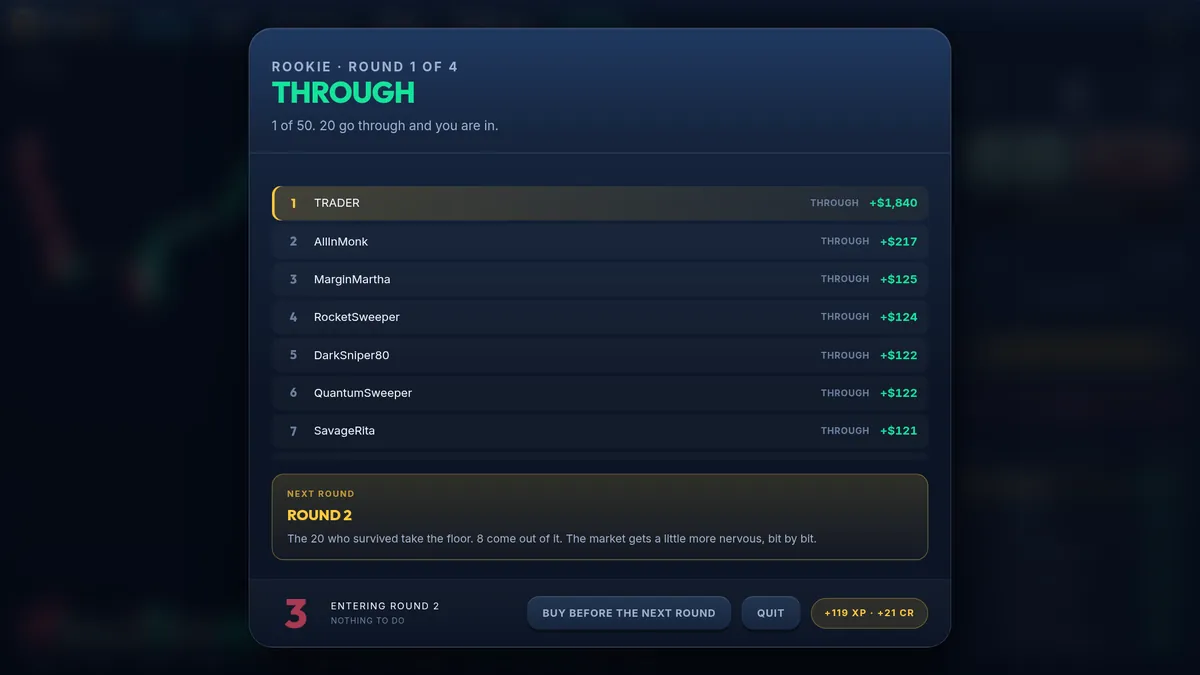
Practise trading less, with a timer running. Play a BullHero tournament with a hard cap of three trades per round and the two-loss pause, then compare your rounds with and without the cap. Everyone in your slot trades the same candles, so the comparison is fair.
Play with a capHow to measure overtrading in your journal
Feelings are unreliable, numbers are not. Once a week, pull these five figures from your trading journal:
- Trades per session against your planned maximum.
- Share of trades with setup "none". The target is zero.
- Trades within five minutes of a loss, and their average result in R.
- Costs as a share of gross profit. As a rule of thumb, above a third means the count is eating your edge.
- Average R by trade number of the day: trades 1 to 3 against trades 4 and later.
The last one is the most revealing. Example: a week of five sessions and 62 trades. The first three trades of each day, 15 in total, made +4.1R. The other 47 made -6.3R. The week closed at -2.2R. With a hard cap of three trades, the same trader would have finished at +4.1R without changing anything else.
Expect the habit to take weeks to break, not a single good day. Track the five numbers for at least a month before deciding whether the rules work; the guide on how long it takes to learn trading explains why progress is measured in hundreds of trades.
Frequently asked questions
How many trades a day is too many?
There is no universal number. Too many is any trade beyond what your written plan allows, or any trade taken without your setup. For beginners, a cap of two or three trades per session is a sensible starting point, because it forces you to choose the best setups and keeps costs low while you learn.
Is overtrading the same as revenge trading?
Revenge trading is one cause of overtrading, not the whole of it. It means trading to win back a loss straight away, often with bigger size. Overtrading also includes boredom trades, chased entries and trades outside your window. A pause after two losses stops most revenge trades but not the other kinds.
Can you overtrade in a demo account or a trading game?
Yes, and it is easier there, because nothing hurts. That makes practice a good place to measure the habit. If you take three times your planned number of trades in a simulator, you will probably do the same with real money, only with real costs attached.
BullHero is a trading game played with play money on prices from a mathematical model; it is not a broker and offers no access to real markets. This article is for education and is not financial advice.
Sources
- Barber and Odean, Trading Is Hazardous to Your Wealth: The Common Stock Investment Performance of Individual Investors, Journal of Finance, 2000
- Kahneman and Tversky, Prospect Theory: An Analysis of Decision under Risk, Econometrica, 1979
- CME Group, Micro E-mini Nasdaq-100 Futures: Contract Specifications, 2019
More articles
False breakouts: how to spot a fakeout early and trade it
Price pokes above the level, your stop fills, then it turns. Why that happens, how to read a fakeout in the first candles, how to trade the failed breakout and how to stop being the liquidity.
Price action trading: read the chart before the indicators do
Swing points, higher highs and higher lows, ranges, key levels and rejection candles, then three classic setups with entry, stop and target in points, how volume confirms them and how to train your eye.
How to write a trading plan you will actually follow at 9:45 a.m.
The six sections every plan needs, a complete one-page example for an intraday NQ and MNQ trader, how to test it before real money and how many trades it takes before a rule deserves to change.