
Published on November 13, 2026 · 9 min read
Micro futures for beginners: MNQ and MES in real numbers
What the Micro E-mini Nasdaq-100 and S&P 500 are worth per point and per tick, when they trade, why they make proper sizing possible on a small account and where their costs bite.
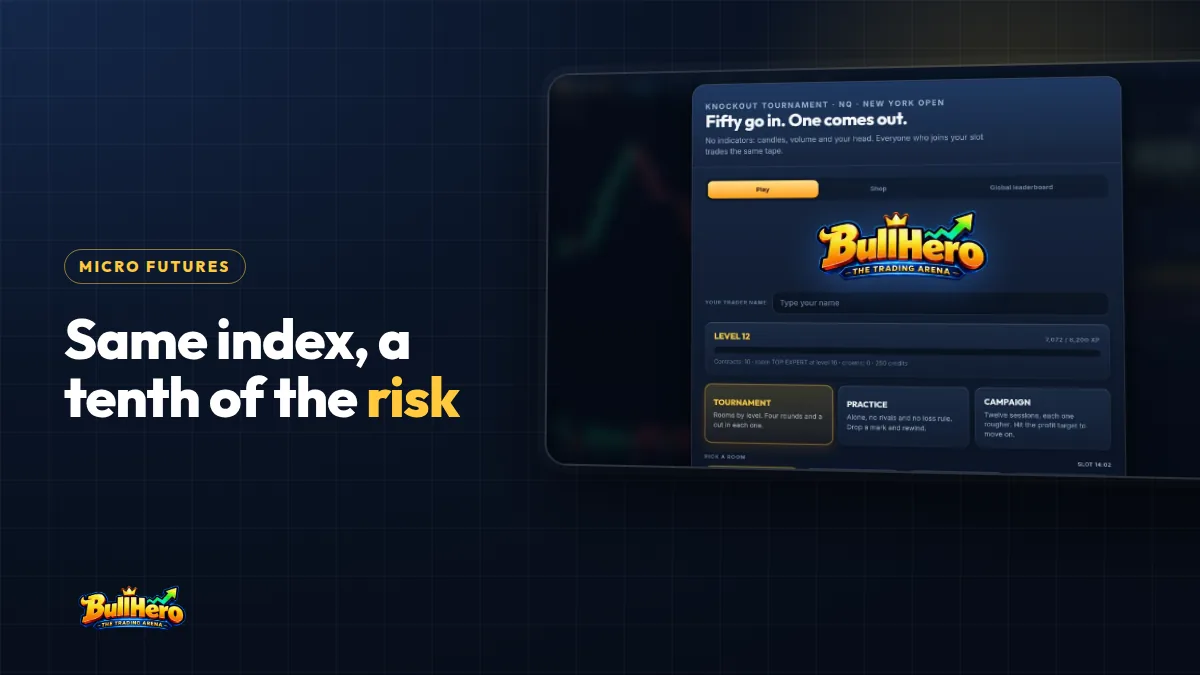
Micro futures are smaller versions of CME Group's equity index futures, launched in May 2019. The Micro E-mini Nasdaq-100 (MNQ) is worth 2 dollars per index point and the Micro E-mini S&P 500 (MES) 5 dollars per point: one tenth of the NQ and ES contracts. Same index, same price, same hours, a tenth of the dollar risk per point. That is what makes proper position sizing possible on a small account.
In short
- MNQ: 2 dollars per point, a 0.25-point tick worth 0.50 dollars. MES: 5 dollars per point, 1.25 dollars per tick.
- They trade nearly 24 hours, Sunday evening to Friday afternoon New York time, with a daily one-hour break.
- Their real value is granularity: you can size in tenths of a full contract, so your stop can sit where the chart says.
- Costs per contract are lower but not ten times lower, so fees take a bigger share of each trade.
What are micro futures?
A futures contract has a fixed multiplier: how many dollars it gains or loses per point of the underlying index. For years, the smallest stock index contracts on CME were the E-minis, with NQ at 20 dollars per Nasdaq-100 point and ES at 50 dollars per S&P 500 point. For a small account, a single E-mini was often too big to trade with a sensible stop.
In May 2019, CME Group launched the Micro E-mini equity index futures at one tenth of the E-mini size: MNQ on the Nasdaq-100 and MES on the S&P 500, alongside micro versions of the Dow and the Russell 2000. They track exactly the same index, quote the same price as their larger siblings, expire quarterly (March, June, September and December) and settle in cash. CME also lists micro contracts in other markets, including gold, crude oil and bitcoin.
If the full-size contract is still new to you, the guide on the Nasdaq NQ future in numbers that matter covers the basics this article builds on.
MNQ vs NQ and MES vs ES: the numbers side by side
| Contract | Dollars per point | Tick size | Tick value | 10-point move |
|---|---|---|---|---|
| NQ (E-mini Nasdaq-100) | 20 | 0.25 points | 5.00 dollars | 200 dollars |
| MNQ (Micro Nasdaq-100) | 2 | 0.25 points | 0.50 dollars | 20 dollars |
| ES (E-mini S&P 500) | 50 | 0.25 points | 12.50 dollars | 500 dollars |
| MES (Micro S&P 500) | 5 | 0.25 points | 1.25 dollars | 50 dollars |
Two details to remember. Ten micros equal one E-mini in dollar exposure, but not in cost (more on that below). And points are not comparable across indices: the Nasdaq-100 sits at a much higher level than the S&P 500, so a 10-point move in NQ is a far smaller percentage move than 10 points in ES. Compare contracts in dollars of risk, not in points.
Micro futures trading hours
MNQ and MES trade on CME Globex on the same schedule as the E-minis: from Sunday 6:00 p.m. to Friday 5:00 p.m. New York time, with a daily break from 5:00 to 6:00 p.m. Check CME's contract page for holiday schedules, which change the hours several times a year.
Nearly 24 hours does not mean 24 equally good hours. Volume concentrates in the US cash session, from 9:30 a.m. to 4:00 p.m. New York time, and especially in the first hour, when ranges are widest. The guide on why the first hour after the Wall Street open is a different market explains why. Outside the US, from early November to mid-March the 9:30 a.m. open falls at 2:30 p.m. in London, 8:00 p.m. in India and 1:30 a.m. the next day in Sydney. Daylight saving changes shift those times during the rest of the year, so check them twice a year.
Why micro futures make risk management possible on small accounts
Sound sizing starts from the stop: contracts = dollar risk ÷ (stop in points × dollars per point). With full-size contracts, the formula often returns a number below one, and you cannot trade 0.4 of an NQ. Take a 5,000 dollar account risking 1% (50 dollars) with a 20-point stop:
- NQ: 20 × 20 = 400 dollars per contract. 50 ÷ 400 = 0.125. The trade does not fit; one contract would risk 8% of the account.
- MNQ: 20 × 2 = 40 dollars per contract. 50 ÷ 40 = 1.25, so one contract, risking 0.8%.
Micros give you steps of one tenth of an E-mini. That lets you keep the stop where the chart puts it and adjust the size, instead of squeezing the stop to fit a contract that is too big. It also lets you scale: with three MNQ you can take one off at the first target and trail the rest, something impossible with one NQ. The risk management guide for beginners builds a full routine around this. For what the contract size does to your exposure, see leverage in trading.
Worked example: a 20-tick stop in MNQ vs NQ
A 20-tick stop is 5 points (20 × 0.25). Suppose you also aim for 40 ticks, 10 points, so 2R.
- Risk per contract. MNQ: 20 × 0.50 = 10 dollars. NQ: 20 × 5 = 100 dollars.
- Reward per contract. MNQ: 40 × 0.50 = 20 dollars. NQ: 40 × 5 = 200 dollars.
- Share of a 3,000 dollar account. One NQ risks 3.3% per trade; three losses in a row cost about 10% of the account. One MNQ risks 0.33%; three MNQ risk 30 dollars, a round 1%.
- Is the stop realistic? Five points is tight for NQ around the New York open, when normal noise can exceed that in seconds. With MNQ you can afford a structural stop of 20 points (80 ticks, 40 dollars per contract) and still risk only 1.3% of 3,000 dollars with one contract.
The lesson of step 4 matters more than the arithmetic. Micros do not just make losses smaller; they let you put the stop in the right place without breaking your risk rule.
Costs: why commissions matter more on micros
Per contract, micro commissions and exchange fees are lower in dollars, but nowhere near ten times lower. As an illustration only, suppose an all-in round-turn cost of 1.50 dollars per MNQ and 5 dollars per NQ (your broker's figures will differ, so check them):
- Same exposure, more cost. Ten MNQ equal one NQ in exposure but cost 15 dollars per round turn instead of 5.
- Cost in ticks. 1.50 dollars is 3 MNQ ticks; 5 dollars is 1 NQ tick. Every MNQ trade starts three ticks behind before the spread.
- Cost as a share of risk. On the 20-tick stop above, 1.50 dollars is 15% of the 10-dollar risk on MNQ, while 5 dollars is 5% of the 100-dollar risk on NQ. With an 80-tick stop, the MNQ share drops to under 4%.
The practical consequence: micros reward wider, structural stops and fewer trades. Scalping for 4 ticks on MNQ means fees can take a large share of every win. The spread is usually one tick on both contracts during liquid hours, which is 0.50 dollars on MNQ and 5 dollars on NQ: the same in ticks, so it does not change the comparison.
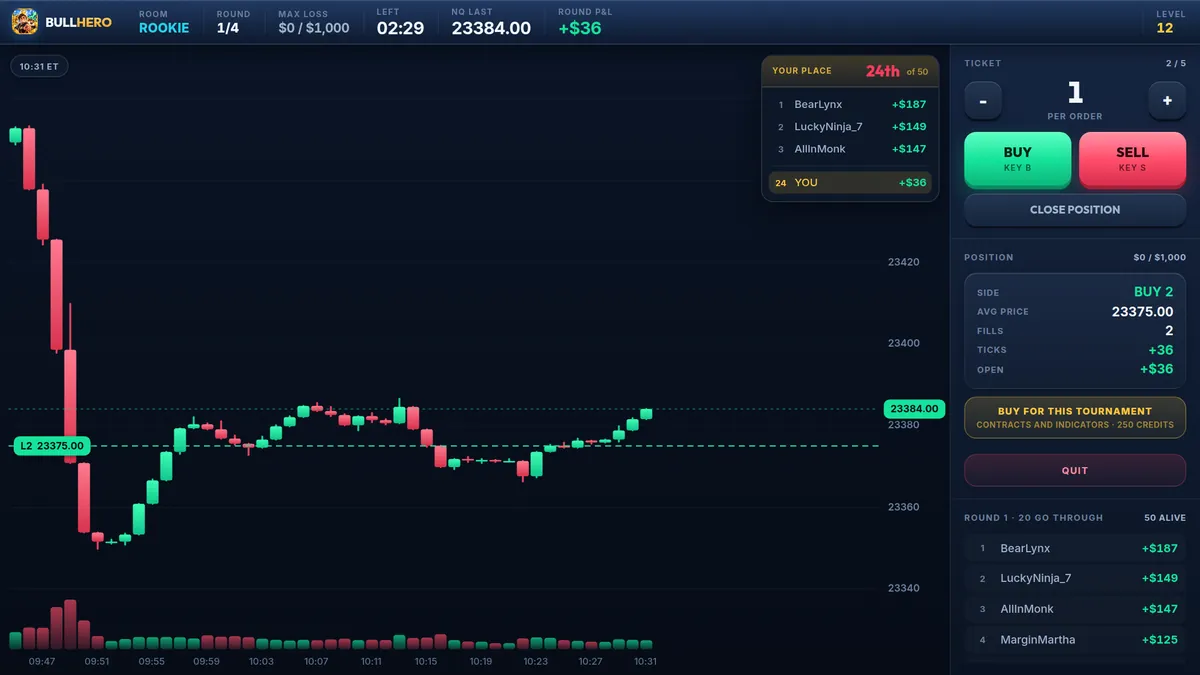
Practise the micro mindset: fewer contracts, better stops. In BullHero you start with 5 contracts on an NQ-style tape with spread and commission on every trade. Use one or two, put the stop where the chart says, and see how much calmer the round feels.
Play a roundHow to start trading micro futures: a checklist
- Learn the tick values by heart. MNQ 0.50, MES 1.25, NQ 5, ES 12.50 dollars per tick.
- Check your broker's margin and fees. Margins are set by the exchange and brokers and change with volatility, so read the current figures rather than any number quoted online.
- Pick one contract and one session. MNQ in the New York morning, for example.
- Write your risk per trade and daily loss limit in dollars before the first order.
- Practise the order ticket in simulation: brackets, stop orders, flattening a position fast.
- Trade one contract for your first 50 live trades, whatever the formula allows, and log every one in R.
- Know the roll. About a week before the quarterly expiry, volume moves to the next contract month. Trade the one with the volume.
If you are still deciding whether intraday trading fits you at all, start with day trading for beginners.
Frequently asked questions
How much money do you need to trade micro futures?
It depends on your broker's margin, which changes, and on your own risk rule, which does not. Work backwards: if you will risk 1% per trade and your stops are around 20 points on MNQ (40 dollars per contract), you need about 4,000 dollars to risk 40 dollars per trade. A smaller account forces tighter stops or larger percentage risk.
Are micro futures good for beginners?
They are the most practical way for a small account to trade index futures with sensible sizing, because the stop can sit where the chart says. They are still leveraged products: one MNQ controls the index level times 2 dollars, tens of thousands of dollars of exposure. Smaller contracts reduce the size of mistakes, not the chance of making them.
Do MNQ and NQ always have the same price?
For the same contract month they track the same index and trade at practically the same price, because arbitrage keeps them aligned. Only the multiplier differs: 2 dollars per point for MNQ, 20 for NQ. You can mark your levels on an NQ chart and execute in MNQ; many traders do exactly that.
Can I hold micro futures overnight?
Yes, but brokers usually require more margin outside the day session, and price can gap on overnight news or data released before the New York open. A stop order does not guarantee its price in a gap. If you hold overnight, size for the gap you could face, not only for the stop distance.
BullHero is a game with play money and an NQ-style price tape generated by a mathematical model; it is not a broker and does not offer real futures. This article is educational only, not financial advice, and contract details should be checked with CME Group and your broker.
Sources
- CME Group, Micro E-mini Nasdaq-100 Futures: Contract Specifications, 2019
- CME Group, Micro E-mini S&P 500 Futures: Contract Specifications, 2019
- CME Group, E-mini Nasdaq-100 Futures: Contract Specifications, 1999
More articles
FOMO in trading: why you chase candles and 7 rules that stop it
The classic late entry, taken apart with real maths: how loss aversion, social proof and recent wins push you into a move that has already happened, and seven practical rules that break the habit.
Best trading indicators: what each one is good for, and its trap
Eight indicators every trader meets, what each one measures, where it helps and how it misleads, a comparison table by type and a simple method to cut your chart down to two or three tools.
Leverage in trading: what it really does to your account
One NQ contract controls hundreds of thousands of dollars of index. What that means for a 1% move, how margin and margin calls work, why losses grow as fast as gains and how to let your stop set the size.