
Published on November 17, 2026 · 10 min read
FOMO in trading: why you chase candles and 7 rules that stop it
The classic late entry, taken apart with real maths: how loss aversion, social proof and recent wins push you into a move that has already happened, and seven practical rules that break the habit.
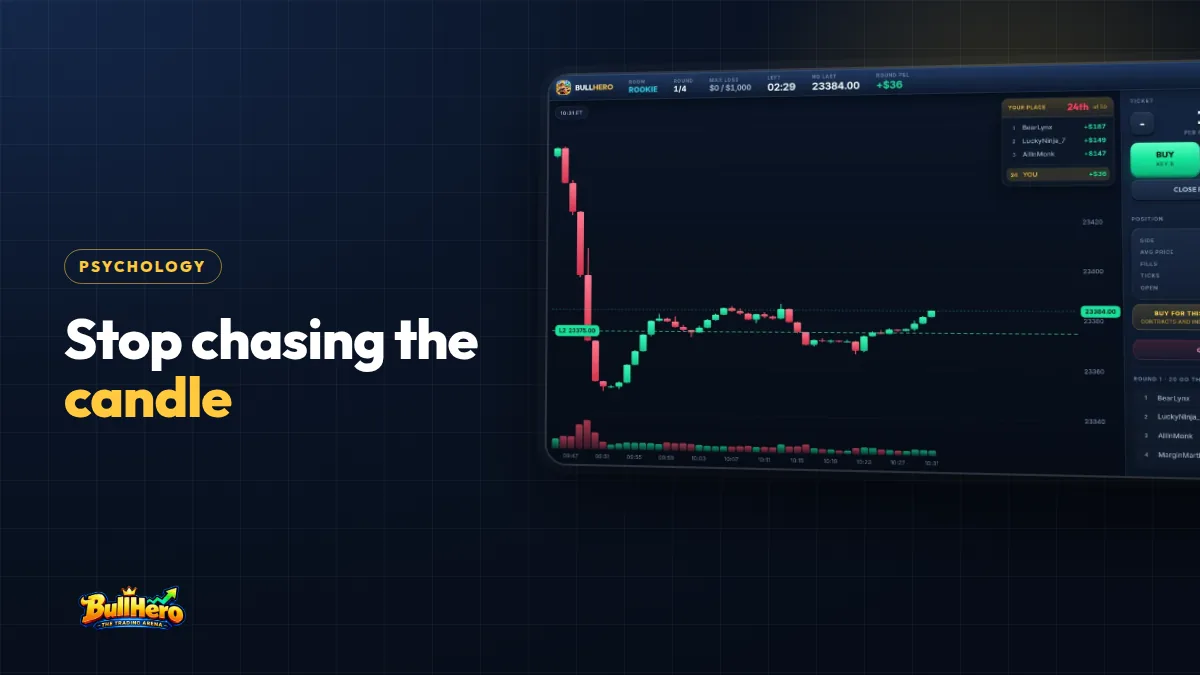
FOMO in trading, the fear of missing out, is the urge to enter a move because it is leaving without you, not because your plan says so. It usually ends the same way: you buy a candle that has already run, with a wider stop and a smaller target, and the first pullback takes you out. The cure is not more willpower. It is a short set of rules you write before the move starts.
In short
- FOMO is a late entry dressed up as an opportunity: the move is real, your price is not.
- Chasing 12 points on NQ can turn a 2 to 1 trade into one that needs a 73% win rate just to break even.
- Three mental shortcuts drive it: loss aversion, social proof and recency.
- If/then rules, price alerts and a maximum chase distance work better than "being more disciplined".
What FOMO in trading feels like
FOMO rarely announces itself. It shows up as a handful of small behaviours in the seconds before a bad entry. If you recognise three or more of these in the same trade, you are no longer trading your plan:
- The cursor hovers over Buy while price is still moving away from your level.
- You switch to a market order because a limit order "might not fill".
- The stop comes later, or not at all, because placing it would show you how far away it is.
- You size up to make up for the points you already missed.
- You narrate the trade to yourself: "it is obviously going higher", "just a quick one".
The common thread is urgency. A planned trade can wait three candles for a retest. A FOMO trade cannot wait three seconds.
Why your brain chases: loss aversion, social proof and recency
FOMO is not a character flaw. It comes from mental shortcuts that serve you well in daily life and badly in front of a chart.
Loss aversion
Daniel Kahneman and Amos Tversky showed in their 1979 prospect theory paper that people weigh losses more heavily than equal gains; later estimates put the ratio at roughly two to one. A missed move is not technically a loss, but once you have imagined the profit, your brain books it as yours. Watching it leave feels like losing money you never had, and the quickest way to stop that feeling is to click.
Social proof
When other people seem to be making money, their behaviour feels like information. Chat rooms, green P&L screenshots and live leaderboards all say the same thing: everyone is in except you. Brad Barber and Terrance Odean found that individual investors are net buyers of attention-grabbing stocks, the ones in the news or trading on unusual volume, while institutions do not show the same pattern. Attention pulls money in, whatever the price.
Recency
The last runner you missed is vivid. Tversky and Kahneman called this the availability heuristic: what comes to mind easily feels more likely. After you watch one breakout run 80 points without you, every breakout looks like the next 80-pointer, and you forget the six that reversed. There is more on how these biases change once your own money is on the line in our guide to trading psychology with real money versus demo.
The classic FOMO trade: chasing a candle that already moved
Here is the pattern almost every intraday trader has lived, on the Nasdaq 100 future (NQ) at the New York open. Your plan says: if price breaks 21,500 and retests it, buy near 21,500 with a stop at 21,490, under the level, and target the next resistance at 21,520.
- At 9:31 a.m. a big green candle breaks 21,500. You wait for the retest, as planned.
- No retest comes. The next candle prints 21,508, then 21,511.
- Nothing in your analysis has changed, but the move is leaving. You buy at market at 21,512.
- Your stop still belongs under 21,490, because that is where the idea is wrong.
- Price pulls back to 21,498 to test the breakout, which is normal. You are 14 points down, and you either panic out or get stopped on a deeper retest just before the move resumes.
Side by side, the damage is plain arithmetic:
| Same move, two entries | Planned entry | FOMO chase |
|---|---|---|
| Entry | 21,500 | 21,512 |
| Stop | 21,490 | 21,490 |
| Target | 21,520 | 21,520 |
| Risk | 10 points | 22 points |
| Reward | 20 points | 8 points |
| Reward to risk | 2 to 1 | 0.36 to 1 |
| Break-even win rate | 33% | 73% |
| Risk per MNQ contract ($2 a point) | $20 | $44 |
The planned trade makes money if it works one time in three. The chase has to work almost three times in four, before spread and commission. If you try to fix it by tightening the stop to 21,502 to keep the risk at $20 per micro contract, the stop now sits inside the normal retest of the breakout, and the pullback you were waiting for is the one that stops you out. A late entry breaks the risk-reward ratio whichever way you adjust it.
What FOMO costs over a month, in numbers
One chase is annoying; a chasing habit is expensive. Take a trader whose planned setup wins 45% of the time, with winners of 2R and losers of 1R (R is the amount risked per trade). The expectancy is 0.45 × 2 minus 0.55 × 1, which is +0.35R per trade.
Now assume, generously, that chased entries still reach the target 60% of the time, but the reward has shrunk to 0.36R as in the table, while losers still cost 1R. That is 0.60 × 0.36 minus 0.40 × 1, or about -0.18R per chase.
- 40 planned trades: 40 × 0.35R = +14R for the month.
- The same 40 trades, 10 of them chases: 30 × 0.35R plus 10 × (-0.18R) = 10.5R minus 1.8R = +8.7R.
Ten chases a month cut the result by about 38%. With R at $50, $700 shrinks to $435, before the extra spread paid on every market order. In practice a losing chase is often followed by a revenge trade, so the real cost is higher. The defence starts with sizing every trade from its stop, as explained in risk management for beginners, so that a chase cannot quietly double your risk.
How do you stop FOMO in trading? 7 antidotes
None of these depends on feeling calmer. They change what you do in the ten seconds when FOMO strikes.
- Write if/then rules before the session. "If price retests 21,500 within three candles, I buy 21,502 with a stop at 21,490. If it does not, I do nothing." The psychologist Peter Gollwitzer called these implementation intentions; his research found that if/then plans are carried out more reliably than plain goals. The "do nothing" branch matters as much as the trade.
- Use alerts instead of staring. Set a price alert at your level and look away. Watching every tick makes every move look like the one you cannot miss. Close chat rooms during the session too; that removes most of the social proof.
- Set a maximum chase distance. Write a number down: for example, no entry more than 3 points past the planned price on NQ. Beyond that the trade is gone, by definition rather than by mood.
- Remember that the next setup always comes. Count your valid setups for two weeks. If your plan produces eight a week, a missed one is one of eight, not the last train out.
- Rest limit orders in advance. A buy limit at 21,502 either fills on the retest or it does not. The decision was made calmly, an hour earlier.
- Size down after a chase. If you break the rule, your next trade is half size or a single micro contract, and a second chase ends the session. This caps the damage of the tilt that usually follows.
- Keep a missed-trade log. For every move you skipped, note what would have happened from your chase price, not from the bottom of the move. Many of those entries would have been stopped out on the pullback.
When a late entry is not FOMO
Not every late entry is a chase. A pullback entry after a breakout you missed can be a good trade, as long as it is a new trade with its own plan:
- A new level: the first pullback, the VWAP, or a broken high that has turned into support.
- A new stop that makes sense from the new entry, not from the old one.
- A new position size, recalculated from that stop.
- A reward of at least your plan's minimum, measured to a real target.
If you can write those four lines in ten seconds, it is a trade. If you cannot, it is FOMO.
How to train calm entries under time pressure
Reading about FOMO does not remove it. It fades through repetitions in which you feel the urge and do not act on it, in a setting with a clock, moving prices and other traders visibly making money. Short timeframes make it worse, which is one reason scalping is so hard on beginners.
BullHero tournament rounds last 2:30 or 3:00 minutes, the tape imitates the NQ at the New York open, and a live list of rivals shows where you stand while you trade. That makes each round a compact FOMO drill:
- Before the round, mark one level and write one if/then rule.
- Write your chase distance in ticks next to the rule.
- Score the round on one number: entries that broke the chase distance. The profit comes second.
- Between rounds, check that number before you look at the standings.
- Aim for ten rounds in a row with zero chases, then add a second rule.
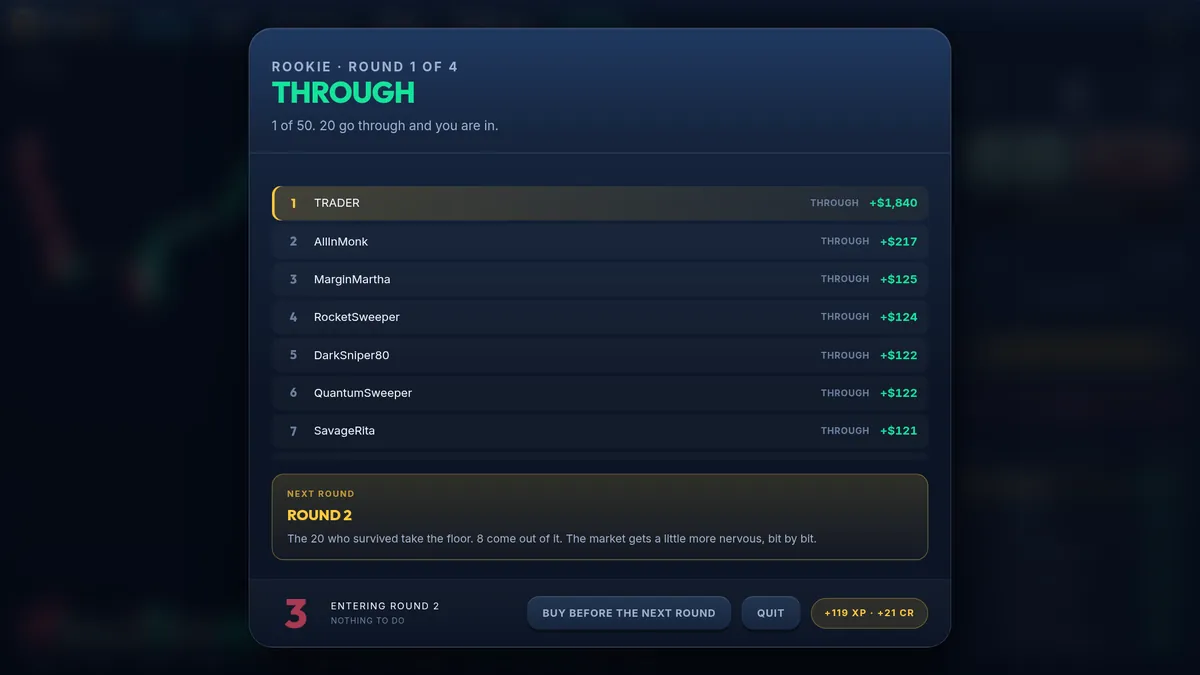
If the leaderboard is too much at first, start in Practice mode, which has no rivals, then move back to tournaments.
FOMO is trained out under pressure, not in theory. Play a few BullHero rounds with a single rule: no entry more than three points past your level. Count the chases instead of the profit and watch that number fall.
Start a tournamentFrequently asked questions
Why do I get FOMO right after a losing trade?
After a loss, the next move looks like a chance to win the money back, so missing it feels doubly expensive. That is revenge trading wearing FOMO's clothes. A simple rule helps: after any loss, wait for one full candle of your timeframe to close before the next entry, and reread your if/then rule before you click anything.
Can chasing a breakout ever be profitable?
Sometimes a chase works, and that is the problem: the one chase that paid keeps the other nine alive. A breakout entry can belong in a plan if the stop, size and target are defined from the entry price and the reward still meets your minimum. If they are not, a winning chase is luck, not a method.
Does FOMO go away with experience?
It gets quieter, but it rarely disappears. Experienced traders still feel the pull; the difference is that their rules decide before the feeling does. Track your chases per week in your journal. If the number is falling, you are making progress, even in weeks when the profit is not showing it yet.
What is the difference between FOMO and overtrading?
FOMO is about timing: entering late because the move is leaving. Overtrading is about quantity: taking trades that are not in your plan at all, often out of boredom or to recover a loss. They feed each other. Our article on how to stop overtrading covers the second habit in detail.
BullHero is a game played with play money on prices generated by a mathematical model; it is not a broker and gives no access to real markets. This article is for education only and is not financial advice.
Sources
- Daniel Kahneman and Amos Tversky, Prospect Theory: An Analysis of Decision under Risk, 1979
- Amos Tversky and Daniel Kahneman, Judgment under Uncertainty: Heuristics and Biases, 1974
- Brad M. Barber and Terrance Odean, All That Glitters: The Effect of Attention and News on the Buying Behavior of Individual and Institutional Investors, 2008
- Peter M. Gollwitzer, Implementation Intentions: Strong Effects of Simple Plans, 1999
More articles
Micro futures for beginners: MNQ and MES in real numbers
What the Micro E-mini Nasdaq-100 and S&P 500 are worth per point and per tick, when they trade, why they make proper sizing possible on a small account and where their costs bite.
Best trading indicators: what each one is good for, and its trap
Eight indicators every trader meets, what each one measures, where it helps and how it misleads, a comparison table by type and a simple method to cut your chart down to two or three tools.
Leverage in trading: what it really does to your account
One NQ contract controls hundreds of thousands of dollars of index. What that means for a 1% move, how margin and margin calls work, why losses grow as fast as gains and how to let your stop set the size.