
Published on November 6, 2026 · 9 min read
Leverage in trading: what it really does to your account
One NQ contract controls hundreds of thousands of dollars of index. What that means for a 1% move, how margin and margin calls work, why losses grow as fast as gains and how to let your stop set the size.
Leverage in trading means controlling a position worth far more than the money in your account. One Nasdaq-100 future (NQ) controls 20 dollars times the index level, about 400,000 dollars with the index at 20,000, while the margin your broker asks for is a fraction of that. Leverage multiplies gains and losses by exactly the same factor, so the safe approach is to size from your stop and let leverage be the result, never the goal.
In short
- Effective leverage is position value divided by account equity. It is what you use, not what your broker allows.
- At 20:1, a 1% move in the index is a 20% move in your account, in either direction.
- Margin is a deposit, not your maximum loss. With futures you can lose more than the margin.
- Choose risk in dollars, measure the stop, compute contracts. The leverage that comes out is a by-product.
What is leverage in trading?
Leverage is exposure larger than your capital. If you have 20,000 dollars and hold a position worth 200,000 dollars, you are leveraged 10 to 1 (10:1). Every 1% the market moves changes your account by about 10%.
Two numbers get mixed up constantly:
- Maximum leverage is what the broker or exchange allows, set by the margin requirement. It is a ceiling.
- Effective leverage is what you actually use: total position value divided by your account equity. That is the number that decides how fast you can lose.
A broker offering 30:1 does not force you to use 30:1. Most of the damage in retail trading comes from treating the ceiling as a target.
How does leverage work in futures? The NQ example
A futures contract has a fixed multiplier. NQ is worth 20 dollars per index point; the Micro E-mini (MNQ) is worth 2 dollars per point. The value a contract controls, its notional value, is the multiplier times the index level. With the index at 20,000 (a round number to keep the maths clean):
- One NQ: 20 × 20,000 = 400,000 dollars.
- One MNQ: 2 × 20,000 = 40,000 dollars.
A 1% move in the index is 200 points. On one NQ that is 200 × 20 = 4,000 dollars; on one MNQ, 400 dollars. Daily moves of 1% are not unusual for the Nasdaq-100. Here is what that does to a 20,000 dollar account:
| Position | Notional value | Effective leverage | 1% index move | Share of account |
|---|---|---|---|---|
| 1 MNQ | 40,000 dollars | 2:1 | 400 dollars | 2% |
| 5 MNQ | 200,000 dollars | 10:1 | 2,000 dollars | 10% |
| 1 NQ | 400,000 dollars | 20:1 | 4,000 dollars | 20% |
| 3 NQ | 1,200,000 dollars | 60:1 | 12,000 dollars | 60% |
Notice that a single full-size NQ on a 20,000 dollar account is already 20:1. The guide to the Nasdaq NQ future in numbers covers ticks, sessions and contract months if you want the full specification.
Leverage with CFDs
A CFD (contract for difference) on an index lets you trade the price change without a futures contract. The broker sets the leverage through the margin it requires. At 20:1, a 1,000 dollar margin opens 20,000 dollars of exposure. If the index falls 5%, the position loses 1,000 dollars: the whole margin, from a move that happens in index markets within weeks and occasionally within a day.
Limits depend on where you live. In the EU, ESMA capped retail CFD leverage in 2018, with 30:1 on major currency pairs at the top and lower caps for indices, commodities, shares and crypto. The UK's FCA and Australia's ASIC adopted similar restrictions, retail clients in the US cannot trade CFDs at all, and other countries such as India apply their own rules. When ESMA introduced the limits, it reported that between 74% and 89% of retail CFD accounts typically lost money. Check your own regulator and broker before assuming any number.
Why leverage magnifies losses as much as gains
The multiplication is symmetric: at 10:1, a 2% move in your favour is a 20% gain, a 2% move against you is a 20% loss. The recovery is not symmetric. A loss needs a larger percentage gain to get back to where you were:
- Lose 10%, and you need +11.1% to recover.
- Lose 30%, and you need +42.9%.
- Lose 50%, and you need +100%.
At 10:1 effective leverage, a 3% move against you takes the account down 30%, and you then need almost 43% just to break even. That is why the data on trading profitability is so harsh on leveraged retail accounts: a few large losses can erase months of small gains.
Leverage and margin: margin calls in plain words
Margin is the deposit that lets you hold a leveraged position. It is not a fee and it is not your maximum loss.
- Initial margin: the amount you need in the account to open the position.
- Maintenance margin: the minimum equity you must keep while the position is open.
- Margin call: what happens when losses push your equity below the maintenance level. You must add money or reduce the position; many brokers close positions automatically, at the market, without waiting for you.
Futures margins are set by the exchange and raised by brokers when volatility rises, sometimes overnight, so treat any figure you see as temporary. Many futures brokers also offer lower intraday margins, which raises the maximum leverage available during the day and changes nothing about how much you can lose per point. With futures, a fast gap can take you past your margin and leave a negative balance you owe. Some CFD regulators, including ESMA, the FCA and ASIC, require negative balance protection for retail clients; futures accounts generally do not have it.
How to size a position so leverage is a by-product
Professional sizing never starts with "how much leverage should I use?". It starts with how much you are willing to lose on this trade, and the leverage falls out of the calculation:
- Set the dollar risk. For example 1% of a 20,000 dollar account: 200 dollars.
- Find the stop from the chart. The level that proves the trade wrong is 25 points away. See where to place a stop loss for how to find it.
- Price the stop per contract. NQ: 25 × 20 = 500 dollars. MNQ: 25 × 2 = 50 dollars.
- Divide and round down. NQ: 200 ÷ 500 = 0.4, so zero contracts: this trade does not fit NQ. MNQ: 200 ÷ 50 = 4 contracts.
- Read the leverage as a check. 4 MNQ at 20,000 is 160,000 dollars of notional, 8:1 effective leverage.
Now change only the stop. If the chart demands a 50-point stop, the same 200 dollars buys 2 MNQ, and effective leverage drops to 4:1. Same risk, half the leverage. The risk management guide for beginners turns this into a routine, and the numbers belong in the risk section of your trading plan.
One extra check: a stop does not protect you from gaps or fast markets. If you hold through scheduled data or overnight, ask what a 2% move would cost and whether you could survive it.
Four leverage mistakes that empty accounts
- Sizing from the margin. "I have 5,000 dollars and margin is X per contract, so I can hold N contracts" answers what the broker allows, not what your stop can survive.
- Adding to a loser. Averaging down raises effective leverage exactly when the trade is proving you wrong. One NQ that becomes three after a 30-point drop has gone from 20:1 to roughly 60:1 on the 20,000 dollar account above.
- Tightening the stop to fit more size. Moving a 25-point stop to 10 points so you can trade 10 MNQ instead of 4 keeps the dollar risk, but puts the stop inside normal noise.
- Forgetting correlation. Long NQ and long ES at the same time is close to one bigger position, because the two indices usually move together. Add their notional values before you call the risk small.
Leverage in BullHero: earned, not handed out
Most platforms give a new user maximum leverage on the first day, which is the worst possible time to have it. BullHero does the opposite. You start with 5 contracts and earn one more every two levels, up to a permanent cap of 20. Each room also limits contracts and sets a maximum loss per round in play money: ROOKIE 5 contracts and 1,000 dollars, up to TOP EXPERT with 20 contracts and 2,500 dollars.
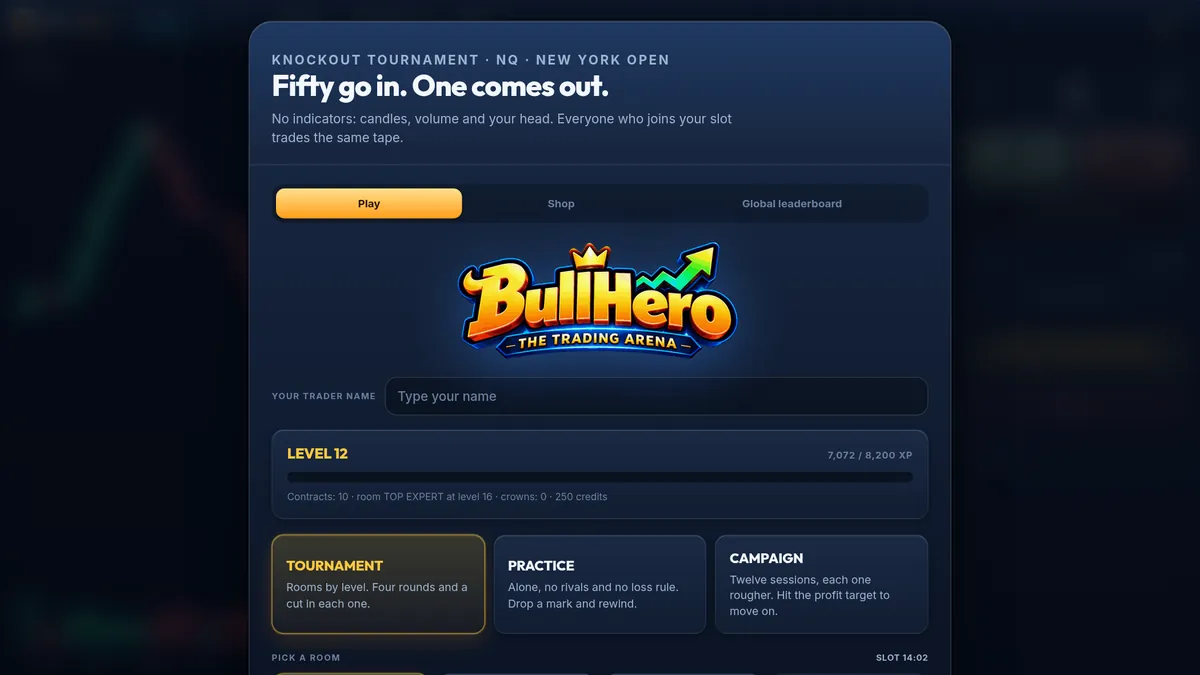
The useful exercise is to not use all of it. With 5 contracts available and a wide stop, trade 1 or 2 and see how the round feels when a sweep runs against you. Having size available and choosing not to use it is the habit that matters with a real broker.
Practise sizing down when the stop is wide. In each BullHero round, decide the stop first, then the number of contracts, and finish inside the room's loss limit. Your level decides how much size you can use, never how much you must.
Practise sizingFrequently asked questions
What leverage ratio is good for a beginner?
There is no correct ratio, because leverage should come out of your sizing, not go into it. A practical test: work out what a 1% move in the underlying would cost you with your current position. If that figure is larger than your daily loss limit, your effective leverage is too high for your plan, whatever the ratio is called.
Can you lose more than you deposit with leverage?
With futures, yes: a gap or a very fast market can push losses beyond your account balance, and you owe the difference to the broker. Some regulators require negative balance protection on retail CFD accounts, which limits losses to the deposit, but that is a rule of specific jurisdictions and products. Check what applies to your account before trading.
Is leverage the same thing as margin?
They are two sides of the same rule. Margin is the deposit required per position; maximum leverage is the position value divided by that deposit. A 5% margin requirement allows 20:1. The leverage you actually run depends on how many positions you open compared with your account equity, not on the margin rate alone.
BullHero is a game with play money and prices from a mathematical model; it is not a broker and offers no real leverage or market access. This article is educational, not financial advice, and leverage rules vary by country and broker.
Sources
- ESMA, ESMA agrees to prohibit binary options and restrict CFDs to protect retail investors, 2018
- FCA, PS19/18: Restricting contract for difference products sold to retail clients, 2019
- ASIC, Corporations (Product Intervention Order: Contracts for Difference) Instrument 2020/986, 2020
- CME Group, E-mini Nasdaq-100 Futures: Contract Specifications, 1999
More articles
False breakouts: how to spot a fakeout early and trade it
Price pokes above the level, your stop fills, then it turns. Why that happens, how to read a fakeout in the first candles, how to trade the failed breakout and how to stop being the liquidity.
Price action trading: read the chart before the indicators do
Swing points, higher highs and higher lows, ranges, key levels and rejection candles, then three classic setups with entry, stop and target in points, how volume confirms them and how to train your eye.
How to write a trading plan you will actually follow at 9:45 a.m.
The six sections every plan needs, a complete one-page example for an intraday NQ and MNQ trader, how to test it before real money and how many trades it takes before a rule deserves to change.