
Published on October 27, 2026 · 10 min read
How to write a trading plan you will actually follow at 9:45 a.m.
The six sections every plan needs, a complete one-page example for an intraday NQ and MNQ trader, how to test it before real money and how many trades it takes before a rule deserves to change.
A trading plan is a one-page set of rules, written before the session, that says what you trade, when, which setups you take, how much you risk and when you stop for the day. To write one, fill in six sections: goals and limits, market and session, setups, risk, routine and review. Below you get each section, a filled-in plan for an intraday MNQ trader and the sample size you need before changing it.
In short
- A rule belongs in the plan only if you can check it with yes or no after the session.
- Risk comes before setups: size is the stop distance turned into dollars, never a feeling.
- Test the plan in replay and simulation before money, and judge adherence before results.
- Do not change a rule after 20 trades. Review at 50, decide at 100, one change at a time.
What should a trading plan include?
A trading plan is a set of decisions you make while calm, so you do not have to make them while NQ moves ten points in four seconds. The test for every line: after the session, can you answer "did I follow this?" with yes or no? "Be patient" fails. "No entry before 9:45 a.m. New York time" passes. Write the six sections in this order, because each depends on the one before.
1. Goals and limits
Set process goals, not money goals. "Make 500 dollars a week" is outside your control; "follow every rule on 95 of my next 100 trades" is inside it. Then write the account limit: the drawdown at which you stop trading live and return to simulation, for example 20% below your starting balance.
2. Market and session
One market, one session: which contract (NQ or MNQ, front month), which hours, which days you skip. The New York cash open at 9:30 a.m. ET brings the most volume, so many intraday traders work only the first 90 minutes. Add the calendar rule: what you do around scheduled data such as CPI at 8:30 a.m. or releases at 10:00 a.m.
3. Setups with entry and exit rules
Each setup gets five lines: the context where it is valid, the exact trigger, where the stop goes and why, the target, and when you skip it. Beginners should write one or two setups, not six.
4. Risk per trade and daily loss limit
Size follows from the stop: contracts = dollar risk ÷ (stop in points × dollars per point). A common guideline is to risk 0.5% to 1% of the account per trade, with a daily loss limit of two or three times that. The risk management guide for beginners explains why size comes before the entry. Set the daily limit in your platform if it allows it, so the rule does not depend on willpower.
5. Routine
Before the open: mark the previous day's high, low and close, the overnight high and low, and check the calendar. During the session: a short checklist before every entry. After the close: log every trade with a screenshot.
6. Review
Ten minutes a day to log, thirty on Friday to read the week, a decision point every 50 trades. Track trades taken, percentage inside the rules, average result in R (profit or loss divided by the amount risked) and the largest drawdown.
Trading plan example: an intraday MNQ plan, filled in
A complete plan for a hypothetical trader with a 5,000 dollar account who trades the Micro E-mini Nasdaq-100 (MNQ, 2 dollars per point) in the New York morning. The numbers illustrate the format, not a recommendation.
| Section | Rule | How you check it |
|---|---|---|
| Goal | Follow every rule on 95 of the next 100 trades | Rule column in the journal |
| Account limit | If the balance falls to 4,000 dollars, stop live trading for a month | Balance at the close |
| Market and session | MNQ front month only. Entries from 9:45 to 11:30 a.m. ET; none from one minute before to five minutes after a 10:00 a.m. release | Entry timestamps |
| Setup A | Opening range is the 9:30 to 9:45 high and low. Long after a 5-minute candle closes above the high and the first pullback holds it; stop 2 points below the pullback low; target 2R. Mirror for shorts | Screenshot of every entry |
| Setup B | Price above VWAP for 30 minutes with higher highs. Long on the first touch of VWAP that closes as a rejection candle; stop below that candle; target the session high if it is at least 2R away | Screenshot of every entry |
| Risk per trade | 50 dollars (1%). Contracts = 50 ÷ (stop points × 2), rounded down, max 3. Stop wider than 25 points: skip | Size column in the journal |
| Daily loss limit | 100 dollars or three losing trades, whichever comes first. Maximum four trades a day | Platform limit plus journal |
| Routine | 9:00 to 9:25: levels and calendar. After 11:30: journal and screenshots | Done or not done |
| Review | Friday 30 minutes. Rule changes only at 50-trade checkpoints | Review notes dated |
The size rule in action. Setup A triggers with a 14-point stop: 14 × 2 = 28 dollars per MNQ, and 50 ÷ 28 = 1.78, so one contract. With an 8-point stop: 16 dollars per contract, 50 ÷ 16 = 3.1, so three contracts, also the cap. The same 14-point stop on one full-size NQ (20 dollars per point) would risk 280 dollars, 5.6% of this account. Writing the plan shows you it cannot be followed in NQ before the market does.
Before every entry, the trader reads five questions. Any "no" means no trade:
- Is it between 9:45 and 11:30 a.m., and away from a scheduled release?
- Is this exactly Setup A or Setup B, with every condition met?
- Is the stop placed at a level, and is the size calculated from it?
- Am I under the daily loss limit and under four trades?
- Is the target at least 2R away before the next obvious level?
How to test a trading plan before you risk money
An untested plan is a guess with formatting. Test it in four stages, moving on only when the current one passes.
- Replay 30 to 50 past sessions. Use bar replay and mark every setup that met all the rules, with its result in R. Most traders find their "A setup" appears far less often than they thought.
- Forward test 50 trades in a simulator with the exact size, hours and daily limit. The target is adherence: 48 of the 50 trades fully inside the rules.
- Add pressure. Rules that hold in a quiet replay can break when a clock runs and a limit can remove you. Short timed rounds with a hard loss limit test exactly that.
- Go live at minimum size. One MNQ for the next 20 to 50 trades, same rules. A big drop in adherence compared with the simulator is a psychology problem, not a plan problem.
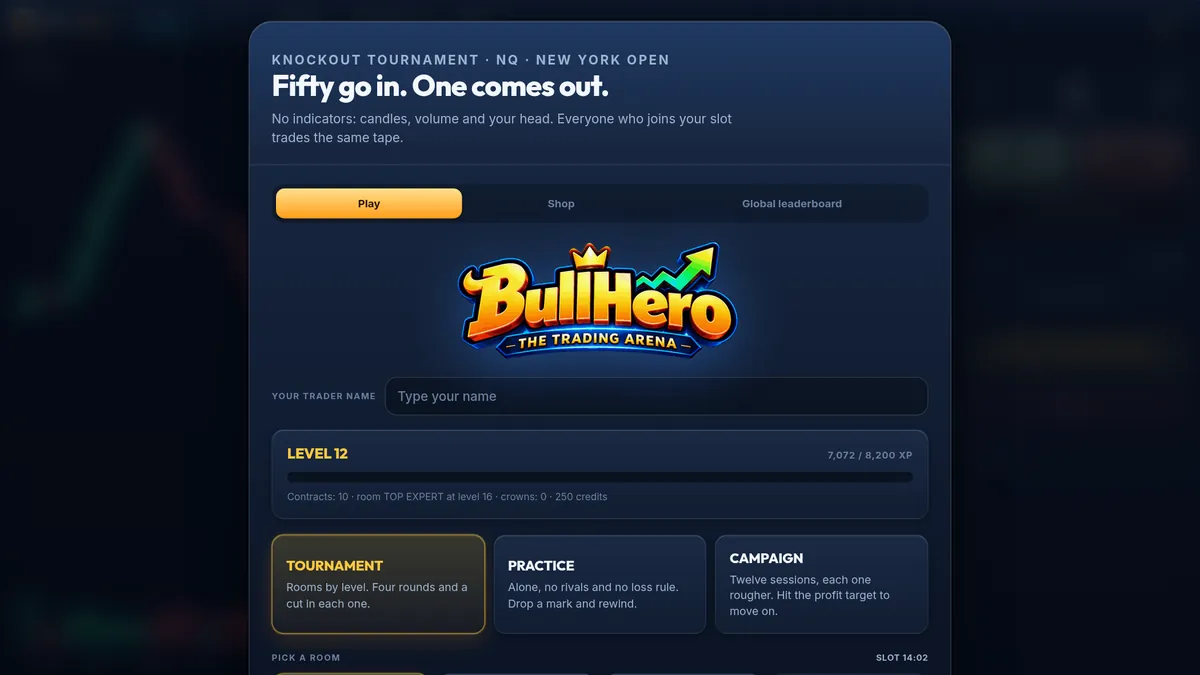
In BullHero each tournament round lasts 2:30 or 3 minutes, fills come at the ask or the bid with spread and commission, and each room has a maximum loss per round (1,000 dollars of play money in ROOKIE) that knocks you out. That stress-tests "only Setup A or B" and "stop at the limit". It cannot test your edge on real NQ, since the prices come from a model, so keep stage 4.
Test your daily loss limit before it costs real money. Play a few BullHero tournaments using only your plan's setups, and count the rounds you finish with every rule respected, stopping included.
Test your planWhen to change your trading plan: sample size first
The surest way to ruin a good plan is to edit it after three losses. Small samples lie:
- Win rate noise. If you win 10 of 20 trades, the true win rate could plausibly be anywhere from about 28% to 72% (a 95% interval). After 100 trades the band narrows to roughly plus or minus 10 points.
- Losing streaks are normal. A setup that wins 45% of the time has about a 92% chance of five losses in a row somewhere in 100 trades, and roughly even odds of seven in a row.
- Positive expectancy can lose for weeks. A 40% win rate with average wins of 2R and losses of 1R gives 0.4 × 2 minus 0.6 × 1 = +0.2R per trade: positive, yet thin enough for a bad month.
Use these rules for changes:
- Check adherence first. If more than one trade in ten broke a rule, the results measure you, not the plan.
- Review at 50 trades, decide at 100. In between, only note ideas.
- Change one variable at a time (the stop rule, or the target, or the session) and restart the count.
- Change immediately only when a risk rule fails, a rule proves impossible to check, or the market itself changes (contract, session, volatility far beyond your plan).
Trading plan vs trading journal
The plan is what you intend to do; the journal is what you did. They only work together if their fields match.
| Trading plan | Trading journal | |
|---|---|---|
| Written | Before the session | After each trade |
| Contains | Rules, limits, setups, routine | Setup name, entry, stop, result in R, rule followed yes or no, screenshot |
| Changes | Rarely, at checkpoints | Every day |
| Answers | What should I do? | What did I do, and did it work? |
Name setups the same way in both, so filtering "Setup B" in the journal gives its real win rate and average R. For the logging side, see how to keep a trading journal.
Five mistakes that make a trading plan useless
- Too long. Nobody reads ten pages at 9:44 a.m. One page, plus the checklist on a sticky note.
- Rules you cannot check. "Trade with the trend" means nothing until you define it, for example price above VWAP with higher highs for 30 minutes.
- Daily money targets. "200 dollars a day" turns a quiet session into a reason to force entries, the shortest road to overtrading.
- No rules for not trading. Skip conditions (data releases, the daily limit, a stop too wide) matter as much as entries.
- Ignoring the gap between knowing and doing. Most plans fail at execution, not design. If you follow your rules in simulation and break them live, read why traders fail with real money and not in demo. If the whole process still feels unclear, start with the order to learn trading from scratch.
Frequently asked questions
Is there a free trading plan template I can copy?
The table in this article is the template. Copy the rows into a document, replace every number with your own account size, contract, session and setups, and keep it to one page. Put the five pre-trade questions on a card next to your screen. A template only helps once every row holds a rule you can check with yes or no.
How long should a trading plan be?
One page for the rules, plus a separate checklist of three to six questions you read before each entry. Background reasoning, examples and screenshots of your setups can live in an appendix. If the core rules do not fit on one page, you probably have too many setups or rules that overlap, and you will not be able to recall them under time pressure.
Do prop firm challenges require a trading plan?
Most funded challenges impose their own risk rules, typically a daily loss limit and a maximum drawdown, and breaking them ends the attempt. They rarely ask to see your written plan, but traders who already work inside a fixed daily limit adapt to those rules far more easily. Check each firm's current terms, since they differ and change often.
BullHero is a game played with play money on prices generated by a mathematical model; it is not a broker and gives no access to real markets. This article is for education only and is not financial advice.
Sources
- SEC, Day Trading: Your Dollars at Risk, 2005
- CME Group, Micro E-mini Nasdaq-100 Futures: Contract Specifications, 2019
- CME Group, E-mini Nasdaq-100 Futures: Contract Specifications, 1999
More articles
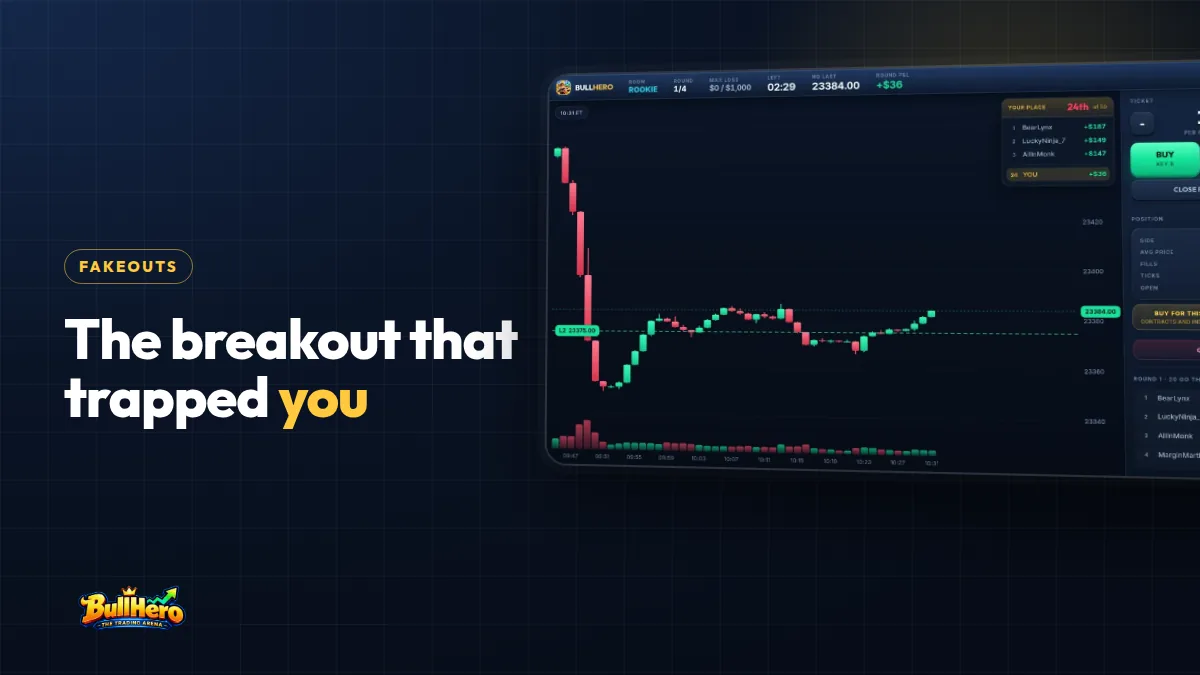
False breakouts: how to spot a fakeout early and trade it
Price pokes above the level, your stop fills, then it turns. Why that happens, how to read a fakeout in the first candles, how to trade the failed breakout and how to stop being the liquidity.
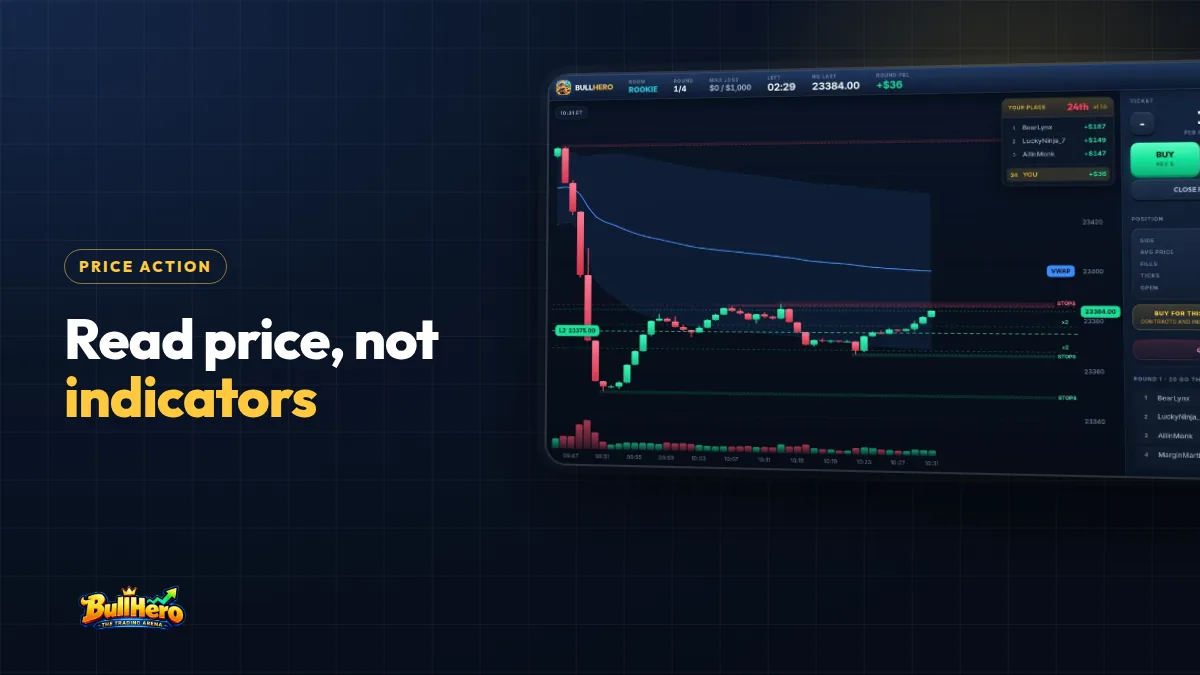
Price action trading: read the chart before the indicators do
Swing points, higher highs and higher lows, ranges, key levels and rejection candles, then three classic setups with entry, stop and target in points, how volume confirms them and how to train your eye.
Overtrading: 6 Warning Signs, What It Costs and How to Stop It
Boredom, revenge and no plan: why traders take too many trades, what costs do to a 40-trade day compared with a 6-trade day, and the rules and journal checks that bring the count back down.