
Published on October 13, 2026 · 9 min read
Day Trading for Beginners: What the Job Looks Like and How to Start
One instrument, one setup, one window: a plain framework for your first year of day trading, the routine around each session, the toolkit you really need and what research on day traders shows.
Day trading for beginners means opening and closing positions within the same session, usually in one liquid market, and being flat before the close. Most of the job is waiting, not clicking: marking levels, taking two or three planned trades with a stop, and logging them. This guide covers what a session really involves, a simple framework to start with, the daily routine, the toolkit and what the research says about your odds.
In short
- A day trader spends most of the session waiting. The work is preparation, a few trades and the review.
- Start with one instrument, one setup and one 60 to 90-minute window.
- The best-known studies show that the large majority of day traders lose money. Plan a learning year, not an income.
- Practise execution with play money or micro contracts before any meaningful size.
What does a day trader actually do in a session?
Forget the image of six screens and constant clicking. A typical morning for someone trading Nasdaq futures around the New York open (times in New York time):
- 8:15 to 9:15, preparation. Check the economic calendar, since many US releases come out at 8:30. Mark the previous day's high, low and close, and the overnight high and low. Write the plan in two lines.
- 9:30, the open. The first minutes are the fastest of the day. Many beginners choose to watch the first 15 minutes and trade after that.
- 9:45 to 11:00, the window. Zero to three trades, each one a setup you named in advance, each one with a stop placed on entry.
- 11:00, done. Platform closed, trades logged, screenshots saved.
That is close to three hours at the desk and perhaps ten minutes of actual decisions. The opening hour behaves differently from the rest of the day, with wider candles, faster reversals and data releases; the guide to why the first hour at Wall Street is a different market explains how.
What the first year of day trading really looks like
There is no official timeline, but most honest accounts of a first year follow the same arc. Think of it as four stages, each with a test you must pass before moving on:
- Mechanics (weeks 1 to 6). Order types, tick values, the platform, the stop placed in under five seconds. Test: 50 simulated trades without a single order mistake.
- One setup in simulation (months 2 to 4). The same pattern, the same window, every day. Test: 100 logged trades and a clear answer to "does this setup make money before my mistakes?"
- Small live size (months 4 to 8). One micro contract. The goal is not profit, it is keeping the same rules when the money is yours. Test: your rule-kept percentage live is close to the one in simulation.
- Review and decide (months 9 to 12). With a few hundred trades logged you can judge the setup and yourself on data, not on the last week.
Expect the first live months to cost money in commissions and mistakes, and decide in advance how much you accept to spend on that stage. The order of skills matters more than the speed; the guide to learning trading from scratch in the right order sets out the sequence.
The minimum toolkit for day trading
You need less than the adverts suggest. One decent screen beats three cheap ones.
| Tool | What it is for | Beginner note |
|---|---|---|
| Regulated broker and platform | Sending orders, holding margin | Must support bracket orders (entry, stop, target together) |
| Real-time data for your instrument | Seeing the price you trade | Delayed data is useless intraday; futures data is often paid |
| Charting | Marking levels and reading structure | The broker's own charts are usually enough at first |
| Economic calendar | Knowing when data hits | Note every release inside your window |
| Journal | Turning trades into data | A spreadsheet with eight fields works |
| Practice environment | Training execution without cost | Demo, replay or a trading game |
Capital is the item that depends most on where you live. Account minimums and leverage limits differ by country, product and broker, and they change. In the US, for example, the 25,000-dollar pattern day trader minimum for stock margin accounts was approved for removal in 2026, with brokers phasing in the change. Futures margins are set by the exchange and by your broker. Check your regulator and your broker before you assume anything.
A simple day trading strategy framework for beginners
Beginners fail less from bad strategies than from too many of them. The framework that removes most of the noise is one, one, one:
- One instrument. A micro future such as MNQ (2 dollars per point, a tick of 0.25 points is 0.50 dollars) lets you keep a sensible stop on a small account. Stick with it for months.
- One setup. For example, a pullback to VWAP after the first 15 minutes, in the direction of the opening move. Write it so a stranger could spot it.
- One window. 9:45 to 11:00 New York time. Outside it, you do not trade, even if something looks perfect.
Add three hard limits: risk no more than 1% per trade, take no more than three trades, and stop for the day after two losses.
Worked example: a 5,000-dollar account risks 1%, so 50 dollars per trade. The setup's stop is 15 points beyond the pullback low, which costs 15 × 2 = 30 dollars per MNQ. 50 ÷ 30 = 1.67, rounded down to 1 contract. A target at 2R is 30 points, 60 dollars. Two losses in a row cost 60 dollars, 1.2% of the account, and end the day. A bad day is capped before it starts.
A daily day trading routine: before, during and after
Before the session (30 minutes)
- Check the calendar and write down any release inside your window.
- Mark the previous day's high, low and close and the overnight range.
- Write the plan as "if, then": "If price pulls back to VWAP after 9:45 and holds, long with the stop under the pullback low."
- Write the day's maximum loss on a sticky note next to the screen.
During the session
- Trade only inside the window and only the setup you wrote.
- Place the stop with the entry, as a bracket order if your platform allows it.
- No new entries in the minute before or after a scheduled release.
- Two losses: close the platform. No exceptions for "one more".
After the session (15 minutes)
Log every trade: setup, reason, stop, size, result in R, emotion and whether you broke a rule. Save a screenshot of each. The guide to keeping a trading journal has a template you can copy and a weekly review to go with it.
Is day trading worth it? What the studies show
Two large studies stand out because they cover entire markets rather than one broker's clients:
- Taiwan. Barber, Lee, Liu and Odean analysed day traders in Taiwan from 1992 to 2006. They found that less than 1% of the day trader population could predictably and reliably earn positive abnormal returns (returns above what the market gave) net of fees.
- Brazil. Chague, De-Losso and Giovannetti (2019) followed every individual who started day trading Brazilian equity index futures between 2013 and 2015 and kept going for at least 300 days. 97% of them lost money. Their conclusion was that day trading for a living is close to impossible for individuals.
Neither study says nobody can do it. They say the base rate is brutal, and costs are a large part of why: every trade pays a spread and a commission, and the more you trade, the more you pay. A beginner who expects to replace a salary in year one is ignoring the only large-sample data available. The guide on whether trading is profitable looks at the numbers in more depth.
The practical answer: treat the first year as education with a fixed budget, never trade money you need, and judge yourself by rules kept, not by the balance.
How to practise day trading for free first
The part of day trading that costs the most to learn with real money is execution: entering on the plan, placing the stop instantly, exiting without freezing. That part can be trained for free.
- Your broker's simulator teaches the real platform and order ticket.
- Market replay, where available, lets you rerun a past open at normal speed.
- A trading game adds what the other two lack: pressure and a loss limit that actually ends your session.
BullHero is built around the moment beginners find hardest. Its synthetic tape imitates NQ at the New York open, with the opening bell, scheduled data and liquidity sweeps, and each order buys at the ask and sells at the bid with spread and commission. Rounds of two and a half or three minutes compress the open into a short burst of decisions, and the ROOKIE room ends your round if you lose 1,000 play dollars.
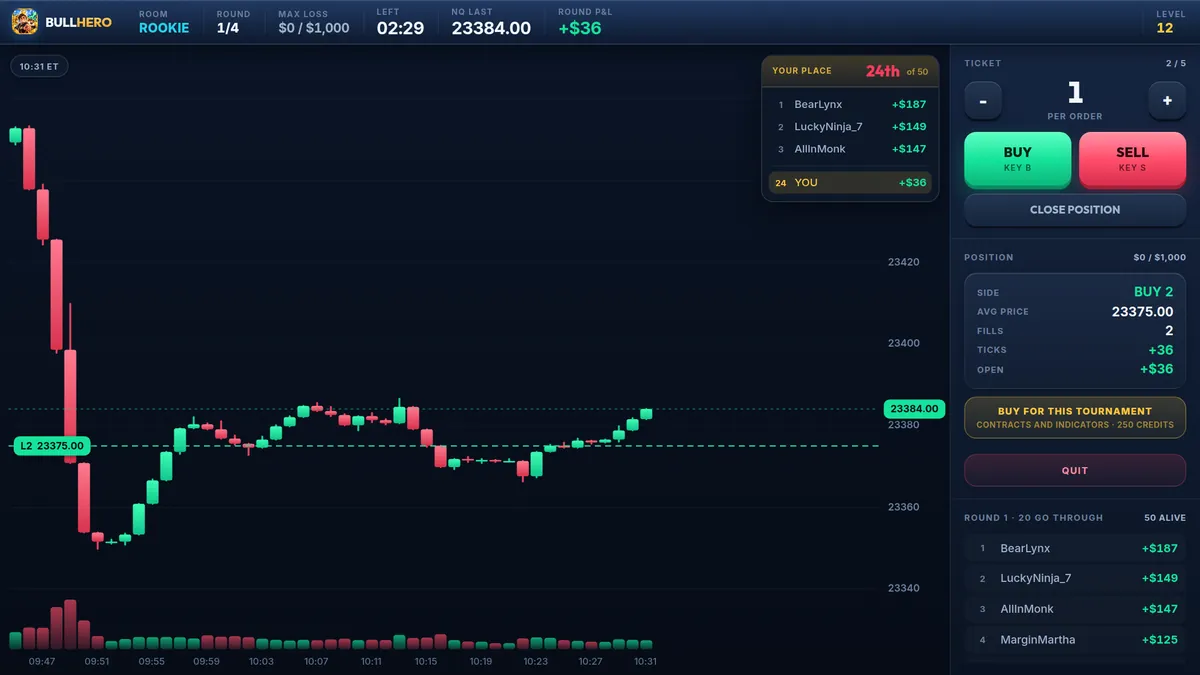
Set yourself a measurable target: 50 rounds in which every position has a stop within five seconds of the fill, and no round ends at the maximum loss.
Train the open before you pay to learn it. In BullHero you can practise your one setup in solo Practice mode, then test it in tournaments where everyone trades the same candles, on the browser or the app.
Practise the openFrequently asked questions
How much money do you need to start day trading?
It depends on your country, the product and the broker, so check with your regulator and broker first. What matters more than the minimum is the risk per trade: if 1% of your account cannot cover a sensible stop on one micro contract, the account is too small for that instrument, and you should keep practising in simulation instead.
Can you day trade with a full-time job?
Sometimes, if your time zone lets you cover a short window. In the UK and Europe the New York open falls in the afternoon, in India in the evening and in eastern Australia around midnight or later. A single 60 to 90-minute window you can protect every day is better than random sessions squeezed between meetings. If you cannot protect the window, practise and review at weekends instead.
What is the best market for day trading beginners?
There is no single best market. A liquid instrument with small contract sizes, such as a micro index future, lets you use a correct stop with small risk. Avoid instruments with wide spreads or thin volume while you learn, because costs and slippage will hide whether your setup works.
BullHero is a game: play money, prices from a mathematical model, no broker and no access to real markets. This article is educational and is not financial or investment advice.
Sources
- Barber, Lee, Liu and Odean, The Cross-Section of Speculator Skill: Evidence from Day Trading, Journal of Financial Markets, 2014
- Chague, De-Losso and Giovannetti, Day Trading for a Living?, working paper, 2019
- CME Group, Micro E-mini Nasdaq-100 Futures: Contract Specifications, 2019
More articles
Where to Place a Stop Loss: 5 Methods With Worked NQ Examples
Five ways to set a stop, worked on NQ in ticks and dollars: beyond structure, ATR multiples, session volatility, time and a hard money cap. Plus why obvious stops get swept and when moving one is allowed.
How to Keep a Trading Journal That Actually Changes Your Results
Eight fields, a template you can copy and a weekly review that hunts for one leak at a time: how to log live trades and practice rounds so your data tells you what to fix next.
Best Apps to Learn Trading: What Each Type Trains and How to Pair Them
Broker demos, charting apps with paper trading, courses, flashcards and tournament games: what each kind of app really teaches, which two to combine and a four-week plan you can run on your phone.